

Story by Jonny Hart, KLN ’18
Photography by Ryan S. Brandenberg, CLA ’14, and Joseph V. Labolito
In the mind of the right researcher, a single observation or idea can spark a revolutionary innovation.
Cardiologist Riyaz Bashir’s observation was simple enough: The devices being used to treat pulmonary embolism (PE), a serious condition where a blood clot blocks blood flow to the lungs, were too small.
“We were using a device designed for a very thin clot to treat one 10 times that size and expecting the same success rate,” he explains.
That was 2014. Almost a decade later, the BASHIR Endovascular Catheter was in the hands of doctors who were using it to save lives.
PE is a global health crisis that affects millions each year and ranks as the third leading cause of cardiovascular mortality, behind heart attacks and strokes. Bashir’s idea for a medical device that treats PE transformed the treatment of the deadly disease ... thanks, in part, to support he got from Temple’s Office of the Vice President for Research (OVPR).

Riyaz Bashir holds his life-saving medical innovation.
“At Temple, we are striving to build a culture of innovation and commercialization,” says Stephen Nappi, associate vice president of technology commercialization and business development within OVPR. “When we can advance a product or technology to the marketplace, that’s when we see the benefit to society. That’s our ultimate goal.”
Nappi’s colleague Niraj Muni, director of commercialization operations, knows all too well that an effective idea can make a real impact. It’s why he leads a team devoted to turning Temple research into practical innovations, through a process called commercialization.
Muni and his staff offer resources and support to Temple faculty in every stage of commercializing their ideas, from filing patents to connecting faculty with entrepreneurs, investors and industry partners who can help bring an idea to the marketplace.
“When a novel idea or invention is disclosed to our office, our innovation managers work with the researchers to strategize for commercialization,” Muni says. “We support innovation for public benefit. We don’t want ideas just sitting on a shelf.”
Dissolving blood clots
The BASHIR Endovascular Catheter expands within a clot, creating multiple fissures and channels that allow the patient’s own healthy blood to carry the body’s clot-dissolving chemicals into the clot.
It’s remarkably effective and requires significantly less medication than traditional methods for treating PE, minimizing the risks associated with high doses of clot-dissolving drugs, which can lead to severe complications like intracranial bleeding.
Still, the invention struggled to gain traction in the medical device space.
That’s where Muni came in. Muni recommended that Bashir submit the invention to the American Heart Association Innovation Challenge, and his office filed for patent protection.
The invention won first prize at the competition, and following the subsequent influx of attention, Bashir began working with a medical device engineer to develop a prototype. At the same time, a spinout company, Thromobolex Inc., was created to further develop the technology and bring it to market.
Today, Thrombolex manufactures eight different FDA-approved devices at its plant in Bucks County, Pennsylvania, and the family of BASHIR Endovascular Catheters are being deployed around the country to save lives.

Stephen Nappi (left), Josh Gladden (center), Niraj Muni (right) and their OVPR staff help faculty turn discoveries into real-world innovations that benefit the Philadelphia region and beyond.
“The view of the city from our window at iNest is really a reminder of why we are here.”
— Josh Gladden
Vice president for research
Regenerating bone tissue
Santiago Orrego, associate professor at the Kornberg School of Dentistry, came to Temple in 2018 with his own groundbreaking idea. Orrego works with piezoelectric materials, a class of smart biomaterials that produce an electrical charge when stimulated by movement or vibration.
As a postdoctoral fellow at Johns Hopkins University, Orrego developed a piezoelectric flag, which generated electricity as it flapped in the wind, and he mobilized that electricity to power electronics in remote locations.
The flapping flag also sparked an idea: Piezoelectric materials could power bone regeneration. Orrego teamed up with Carolina Montoya, research associate at Kornberg, and they began applying piezoelectric technology to grow dental tissue.
The pair went on to develop a gel that uses piezoelectric materials to regenerate bone tissue lost to periodontal disease. After the gel is applied to a patient’s gum and teeth, Orrego explains, it employs biomechanical movement to produce electrical charges that stimulate bone growth.
Many people who are dealing with periodontal disease end up having to undergo surgery. Orrego and Montoya’s gel offers a noninvasive treatment alternative.
“This innovative gel harnesses the power of smart biomaterials to stimulate natural bone regeneration, eliminating the need for invasive surgery and bone grafting while maintaining a supportive healing environment,” Orrego says.
Not long after they developed their idea, Orrego and Montoya stopped by Muni’s office, which is just how Muni likes it. By connecting with researchers at an early stage, Muni feels his team can best support an innovation through the commercialization steps.
Muni was impressed with Orrego and Montoya’s gel. So much so, that his team began filing patents protecting the invention— a crucial step. Without that protection, Muni explains, a discovery would be commercially unviable, and its life-changing potential could easily go untapped.
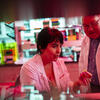
Alla Arzumanyan (left) and Mark Feitelson (right) identified a set of gut metabolites that could be administered in drug form to treat a long list of diseases—much like how insulin is used to manage diabetes.
“Without patent protection the product can’t make money, so the question becomes: Why would a company choose to develop something that costs so much if they can’t get return on their investments?” Muni says.
He then introduced Orrego and Montoya to J. Todd Abrams, director of OVPR’s Innovation Nest (iNest), a physical space dedicated to supporting Temple innovations from an early stage. Abrams leveraged one of OVPR’s most valuable resources: connections—a robust and growing network of entrepreneurs, investors and industry partners throughout the region.
“He started working his Rolodex to identify potential entrepreneurs who would be interested in licensing and developing the technology further,” Muni says. “Todd was instrumental in bringing all of the players together.”
Today, the gel is known as Ambrilux Dental Gel. Oral Biolife Inc., a company based in Bethlehem, Pennsylvania, is now advancing the commercialization of the technology after entering a license agreement with Temple University. Thanks to the pioneering work of its inventors, the discovery progressed through the university’s technology transfer office and is now advancing toward FDA clearance, with a commercial launch targeted for 2026.
Altering the course of disease
Biologists Alla Arzumanyan and Mark Feitelson’s idea is as profound as it is straightforward. The researchers, along with career drug developer Ira Spector, identified a set of gut metabolites that, when given to patients in drug form, could treat a wide range of autoimmune disorders and other illnesses. A metabolite is a small molecule produced by a metabolic reaction in a cell.
Type 1 diabetics lack the ability to effectively produce insulin, but by receiving insulin in drug form, they are able to live healthy lives. Arzumanyan, Feitelson and Spector’s idea is similar.
“There are 300 million patients with autoimmune diseases. Now, imagine that there’s a potential link between them,” says Spector. “We think there is a set of metabolites that they can’t make in their body that we can make and provide for them as a drug.”
Since the treatment uses compounds naturally found in the human body, it eliminates unwanted side effects. Furthermore, in clinical trials with patients suffering from the autoimmune disease psoriasis, the researchers found that patients taking their treatment for long enough periods could sometimes regain the ability to make the metabolites themselves.
That finding is revolutionary, and nothing on the market currently compares, explained Feitelson.
“It’s going to require more research, and it’s going to require longer trials. But if we can create a functional cure, then we have done something that no one’s been able to do in this field,” Feitelson says. “The drugs you see on TV that only treat symptoms will become obsolete, because we’ll have a drug that alters the course of disease.”
The idea originated in 2013, when Arzumanyan and Feitelson came across a scientific article about using gut metabolites to treat colitis in mice. They’ve spent the years since developing the concept in their labs, first testing the treatment in liver cancer, and eventually progressing to clinical trials for humans with psoriasis.
Muni and the OVPR staff have provided support along the way. His office filed patents protecting the invention and later licensed those patents to SFA Therapeutics, a spinout company started by Spector with the intent of commercializing Arzumanyan and Feitelson’s discovery.
“When we can advance a product or technology to the marketplace, that’s when we see the benefit to society. That’s our ultimate goal.”
—Stephen Nappi
Associate vice president of technology commercialization and business development
SFA Therapeutics recently completed a Phase 1B clinical trial for psoriasis treatment and will be publishing findings showing their psoriasis drug is both safe and efficacious. They’re now working on raising money to fund a Phase 2 trial, where they plan to confirm the results from their Phase 1 trials. They hope to one day offer their drugs as treatment for more than 40 autoimmune disorders, certain types of cancers and other illnesses like fatty liver.
Moving discoveries forward
Muni has learned that the steps for bringing an idea to market are different for each innovation, and thus his office offers various kinds of support for researchers at different stages in the process. One important resource is their innovation fund. Temple researchers often receive federal funding from the National Institutes of Health or the National Science Foundation in the early stages of development. But that federal funding can only take an innovation up to a particular point, sometimes referred to as a benchwork, where there is some proof of concept. Muni explained that while it may be possible to file patents at this point, there often isn’t enough momentum to attract serious investors.
“The feedback from the industry is usually, ‘This is too early for us,’” Muni says. This gap between academic research and industry investment is sometimes called the valley of death. “This is where most innovations die. They just cannot cross that valley.”
OVPR launched its innovation fund to help Temple researchers overcome this challenging point in development, perhaps by producing a prototype that researchers can demo for investors and entrepreneurs. This is also where the iNest can come in. Launched in March of 2024, it has quickly become a hub for innovation at Temple.
Located on Broad Street at the Health Sciences Center campus with a clear view of the Center City Philadelphia skyline, iNest offers a wealth of resources that can prove essential for researchers and spinout companies in the early stages of development, like affordable labs, office spaces, conference areas and computing rooms.
“Innovation rarely follows a straight line, so we offer dynamic, adaptive spaces throughout the facility,” Nappi says. “We didn’t want to overdesign because we didn’t want to box out any companies.”
Muni’s office is also strategically located within the iNest, giving researchers easy access to his staff’s expertise and support.
Making safe batteries
One of the spinouts currently incubating at iNest is Inovele LLC, a battery safety company started by Associate Professor of Mechanical Engineering Elham Sahraei.
In 2012, Sahraei was studying lithium-ion battery and vehicle crashes at the Massachusetts Institute of Technology’s Impact and Crashworthiness Lab, when a car traveling at more than 110 miles per hour collided with an electric battery-operated taxi abroad. The resulting scene, with flames engulfing a nearby tree, looked like something out of a Hollywood blockbuster film. This was the first reported electric vehicle crash fire, and suddenly, Sahraei’s research was in great demand.
Now as head of Temple’s Electric Vehicle Safety Lab and the Center for Battery Safety, Sahraei studies the safety of lithium-ion batteries under extreme conditions, with the goal of enhancing safety for people everywhere relying on lithium-ion batterypowered vehicles and devices. With Inovele, Sahraei plans to conduct research directly with industry and government partners to help them design safer, lighter and more efficient battery products, specifically related to electric vehicles.
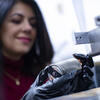
Elham Sahraei is a leading researcher of lithium-ion batteries under extreme conditions. Through her new company, Inovele, she wants to share her expertise with companies and government agencies to help them design safer batteries.

Since opening in March 2024, Temple’s Innovation Nest (iNest) has become a hub dedicated to commercializing new innovations and supporting the growth of startup companies affiliated with the university.
Inovele is a different kind of spinout company in that its expertise in testing and modeling cannot be patent-protected. But, Muni says, the research and expertise the company will provide to the battery and electric vehicle industries is a vital asset to support.
“iNest and our office are not here just to focus on Temple innovations. We are here to support Temple faculty members who are trying to do something innovative, something entrepreneurial,” he said.
Muni hopes Inovele’s research will lead to additional partnerships and intellectual property in the future. He also believes Inovele’s operations will help bolster Temple and Philadelphia’s reputations as hubs of progress and innovation, a mission that is paramount to OVPR.
“Every day, our top-tier faculty push the boundaries of knowledge, making cutting-edge discoveries and generating new intellectual property—often with the potential to become life-saving technologies. Their work drives the creation of new products, companies and jobs that benefit people worldwide and right here in Philadelphia,” says Josh Gladden, Temple’s vice president for research. “The view of the city from our window at iNest is really a reminder of why we are here.”
Temple Innovation by the Numbers
Related News

Temple scientists discover a new way the body repairs itself after heart injury
Researchers in Raj Kishore’s lab have uncovered how circular RNAs, a special kind of genetic material, help cells stay in healing mode.

Temple research brings new voice to people with communication limitations
Stephen MacNeil, Slobodan Vucetic and Eduard Dragut from the College of Science and Technology recently received $1.5 million to advance technology that people with autism and other communication limitations rely on.
Exploring a potential nano-sized solution
New Phase 2 funding from the National Science Foundation will support the Center for Single-Entity Nanochemistry and Nanocrystal Design. Kallie Willets, professor of chemistry in Temple’s College of Science and Technology, will represent Temple University’s efforts in this endeavor in collaboration with either other universities.